Showing posts with label Homestay. Show all posts

Thursday, December 26, 2013

Twinkle

(From December 23, 2013)

The stars were so beautiful tonight.
I was squatting at the tap outside the kitchen door, because I’m on my period so my dishes can’t be washed with anyone else’s. The sun dropped below the hills of the valley long before dinner at 7:30 so by the time I finished eating any traces of dusk’s dim light had disappeared. And it was loadshedding so there was no light flooding over from neighboring houses.
It was dark.
When I reached up to pass the soap back inside to my host sisters, doing the rest of the dishes, I caught a glimpse of the sky. It was like a silver glitter fiasco on a dark blue kindergarten carpet. I finished rinsing and came back inside, happy to put my damp hands into my gloves, hoping they would regain feeling after the freezing tap water.
Up on the roof, I went to the north corner where the light from a nearby hotel’s generator is blocked. I gazed up and marveled at the largeness of the dark and the potency of each star. I threw my head back and leaned until the houses and the hills and the world were completely out of view.
My eyes scanned the grand expanse of the sky and I thought to myself, “wow…it looks just like a planetarium.”
Something tells me that's not how it's supposed to go.


***
Also, if you are interested in learning more about the time I didn't go to Sri Lanka, check out my friend Virginia's blog. I tried and didn't have the emotional stamina to relive the whole experience in writing so I'm especially grateful someone else did. Because this is a story to be told. http://virginiafrommontana.com/2013/12/16/stuck-in-a-glass-box-or-why-i-will-never-again-fly-through-the-delhi-airport/

Friday, November 22, 2013

Spontaneous Holidays and Unexpected School Days

Perhaps one of the most challenging parts of teaching in Nepal is knowing whether or not the school will be open on a particular day. I have basically always taken it for granted that school would follow the calendar published months in advance, with an occasional but widely announced change due to a snow day or two. That is not how it happens here.

Don't assume that February and March will actually include that much school,
it's just too early to know about the unexpected stuff.

I live with another teacher from my school and the headmaster of another local school, so if anyone should be in the know about whether or not school is running, it’s me. But that hasn’t really been my experience. Here is a quick guide to determining whether or not school will be open based on my diligent observations and questioning in a desperate search for answers:

1. Be sure to say “see you tomorrow!” to everyone you encounter at school. Hopefully one of the dozens of students and teachers will pipe up if it has already been determined that school will be closed the following day.

2. Don’t count too strongly on strategy number one. It probably works 50% of the time.

3. Try to make friends with people who are well-connected to the grapevine. This provides access to rumors about upcoming bandhs or poorly publicized local holidays that are approaching. Any kind of a rumor, no matter how seemingly ridiculous, is enough to indicate that school may or may not be closed.

4. Don’t spend too much time asking people. When confronted directly with the question “Is there school tomorrow or not?” in English or in Nepali, most will say “there may be school tomorrow.” Which is a frustratingly vague answer.

5. Definitely don’t try to get an answer the night before. It’s too early. No one knows.

6. In the morning, check with your host family. Questions like “are you going to school today?” generally receive a more informative answer than “is there school today?” Even though it would seem like within three hours of school starting a decision would be clear. If you don’t get a clear answer, check back in 45 minutes; kind of like shaking a magic 8 ball until it gives you what you want.

7. If on the way to school you pass an entire soccer field full of students from grade three, don’t assume this means that school is closed. Simply make a note that class three will be smaller than usual.

8. When in doubt, take everything with you to school on the assumption that even though less than half of the staff have showed up the school will still run and you will suddenly be in charge of way more classes than normal. At least the student numbers will also be running below half so even when the headsir says “you take grades one AND two” the class size won’t be terribly overwhelming.

9. Even if school is running, don’t assume that it will be a full day. Assume that any adult approaching your classroom, at any time during the day, is coming to announce that everyone is leaving at 12:00 or 1:30 or right now. NOTE: DO NOT listen to older students who deliver the same message, always wait for a credible adult who you can identify if later asked “who told you to let all the grade ones go running out the gate?”

10. Laugh. Go with the flow. Bat away a single tear as the time you were going to use to teach that great new game with rhyming words is snatched out from under you. Enjoy the six kids who actually showed up – be sure you know their names and give them an extra star just for coming when no one else did. Sigh as you develop a deeper understanding of why teachers in Nepal are frustrated beyond belief and have no interest in lesson/unit planning. Why plan for a day that may or may not happen? Force a smile when you walk past the seven teachers enjoy their leisure period outside while you run between classes wondering how there can possibly be any spare adults on a day like today. Take the long way home when the day ends three hours early. Buy yourself a pack of oreos at the grocery store to remind yourself that somewhere in the world things are different. Then eat a huge plate of daal bhat to remind yourself that you’re in Nepal whether school runs today or not.

Saturday, November 16, 2013

Tihar


Tihar is a grand celebration basically centered around the victory of good over evil. It is praised as a holiday for all castes and religions and celebrated throughout Nepal. Many people told me that even though Tihar is shorter than Dashain it is their favorite holiday of the year.
 
There is lots to do in terms of decorating the house. Garlands are made and draped on every window and every door. A grand mandala or rangoli is put on the ground outside the house and the path leads all the way to the space inside the home where puja, worship, takes place.

The mandala or rangoli that we created out of tika
powder on the ground in front of the house.
Making the mandala.


A marigold garland along the door frame.


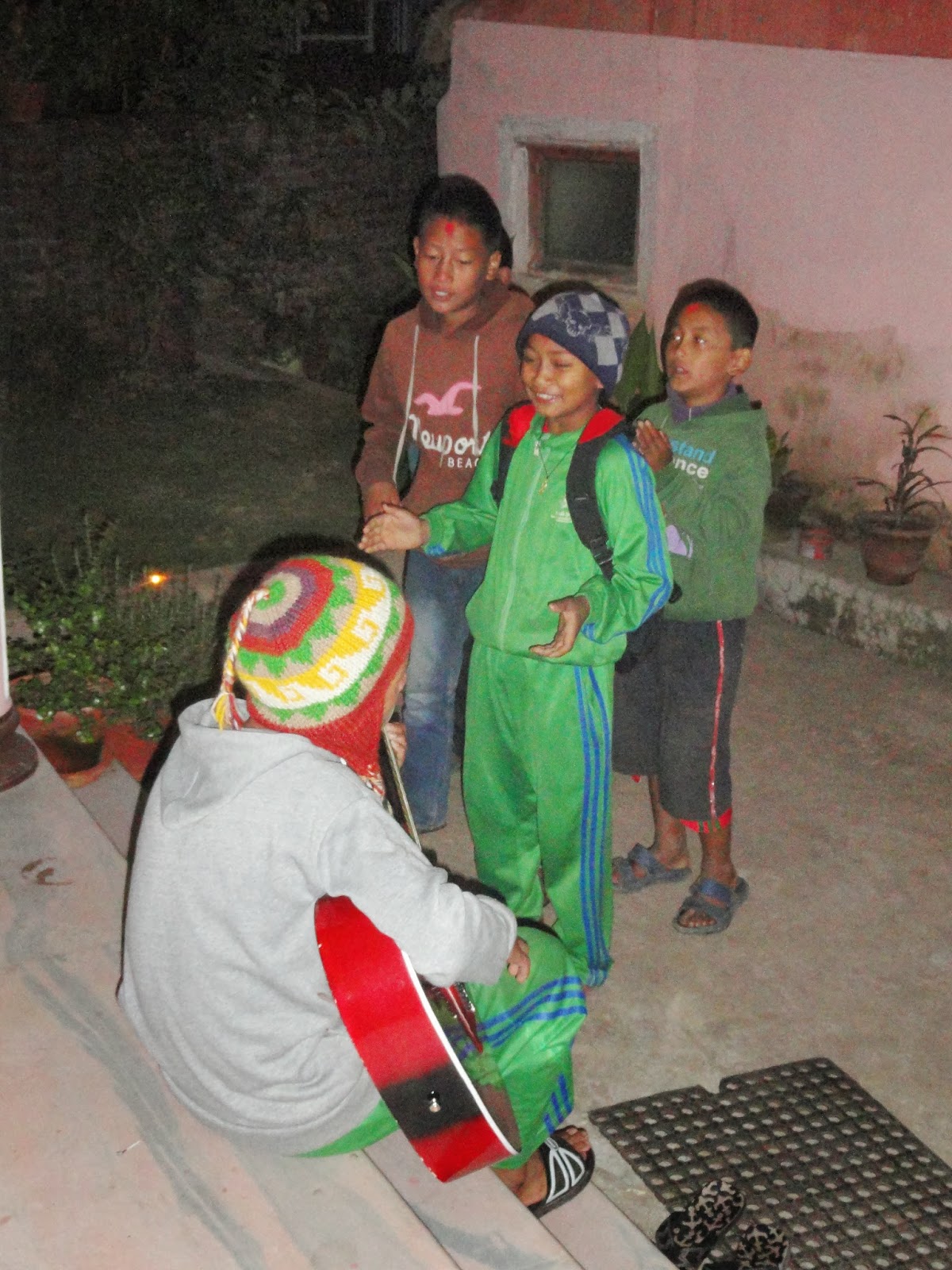
For two nights, all the houses are lit up and groups of kids come around asking for money and gifts. It's like the strange offspring of Christmas and Halloween.
Some electric lights and a lot of candles.
These kids showed off by bringing a guitar. Most groups are just 3-8 children singing/chanting.
 
During the day, kids enjoy giant swings built from rope and bamboo. And by kids I mean kids of all ages. Not only did my host siblings and I enjoy it, but two women who I would guess were in their 50's were waiting in line to take a turn after us! **Correction: giant swings, called pings, are actually constructed for Dashain not Tihar. In my family it just so happened that we didn't find one during Dashain and later happened upon a leftover one.**


The guy in the picture is standing on the swing, he's just got his legs bent to build more momentum.

Worship is directed towards certain things on certain days. There were days of puja for dogs, and crows, cows. My family doesn't have a dog so one of the neighbors brought their dog over and we put a garland and tika on it. There was some confusion regarding the astronomical date for the cow puja. I ended up not being witness to the event because my host mom went and did it early one morning somewhere else since our family does not have a cow.
 
 
It took some convincing (read bribery with food) for the dog to wear the garland.
And the cow is someone else's that I saw in a field on the way to the giant swing.
 
 Using thin twigs and two leaves little "boats" are made. This is what holds the offering during puja.
I asked my host mom to teach me how to make them. It's tricky business!
 
 
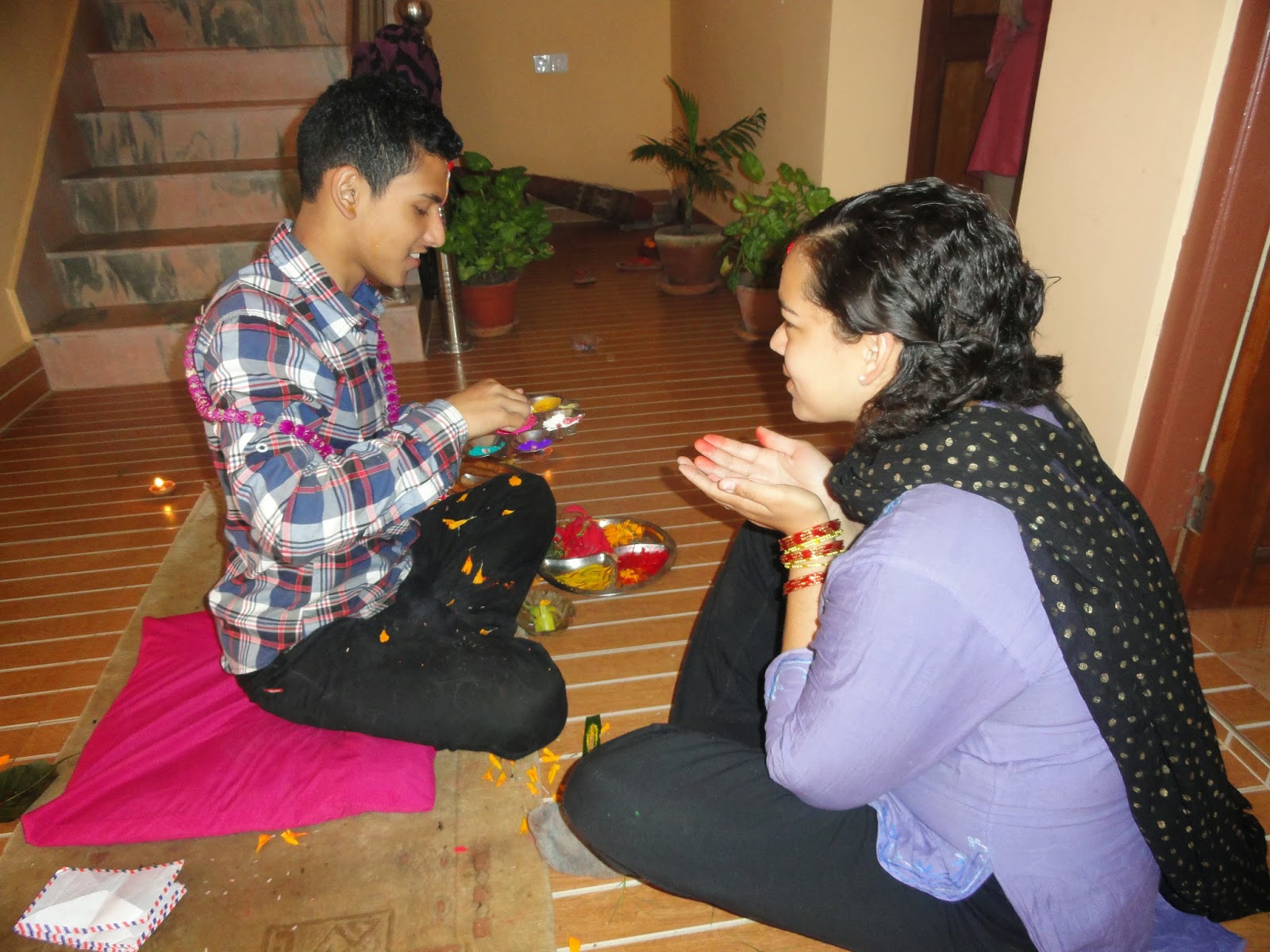
On the last day we celebrated brothers. This involved a particular kind of tika with seven colors; normally there is just red or yellow. Plus lots of gifts --mostly food-- from sisters to their brothers! (But then the brothers have to give money to the sisters.)


**Sorry for the insane photo layout and lack of captions at the end. Sometimes I love blogger and sometimes the way this website handles images makes me want to swear off ever trying to post pictures. But don't worry, I promise not to resort to that! You'll just have to tolerate less than aesthetically pleasing combinations of photos.


Tuesday, September 10, 2013

Holidays: Part Two (Teej)

Teej (pronounced TEA-juh)
Teej is a festival for women. And it’s a big deal. The holiday itself is on Sunday, but the celebrations span many days on either side. The weekend before, my family went to see relatives in Kalanki (part of Kathmandu) for a pre-Teej meal. On the Friday before, all of the female teachers at my school headed into the city for some kind of program/event/party. I went with Sydney, another ETA in Lalitpur, to the Teej Celebration with the ACCESS students. (ACCESS is a U.S. Embassy program providing extra English classes to academically talented but financially disadvantaged students in Nepal’s government schools.) I don’t know what I was expecting the program to be like, but it was pretty much all dancing. Oh, except the part where Sydney and I were asked to “say a few words” with less than 30 seconds warning. At least we were able to leave before they asked us to dance in front of everyone!

The group photo, sorry for the quality it wasn't my camera.
One of the dances performed by the access students.

During Teej, women fast to improve their chances of getting a good husband and/or to improve their husband’s chances of living a long and prosperous life. Just another example of women doing all the work! Although men may be at the motivation of the holiday, the festival really is for the women. Everyone dresses up and spends the whole day at the temple singing and dancing. How strict you choose to fast is kind of an individual decision, with more and more women becoming pretty relaxed, although some still commit to abstaining from even water between dawn and dusk. Of course, Nepali stomachs are used to giant platters of rice so in preparation for a single day of fasting you eat like there will be an eternal famine. Fortunately, my family is now accustomed to the fact that I am a dinner time annomally, and they just laugh when I thrust my left hand (unclean) over my plate and yell pugyo! as my aama comes toward me with a second person’s worth of rice.

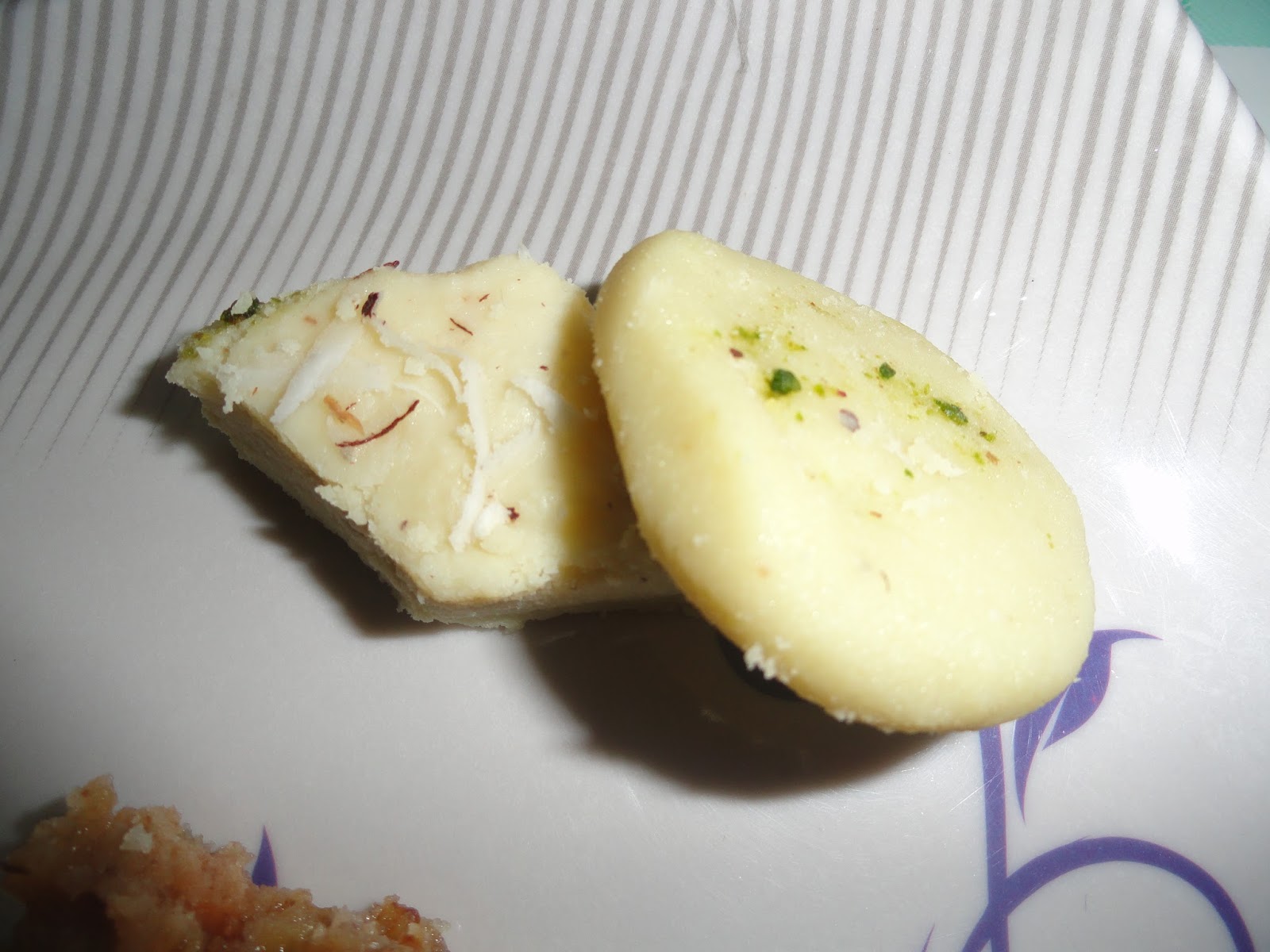
This was my first opportunity to experience many of the festival sweets, including one called barfi which is actually pretty tasty once you can get the unpleasant vomit image out of your mind. 

 lalmon and yogurt: a ball of fried dough soaked overnight in a sugar syrup
 
 barfi and pehda: both are sweets made from concentrated milk
(Milk can be turned into a lot of things here with varying consistencies, I don't ask too many questions.)
 
Japanese Pears and Gudhpak: the second thing is a mix of dried fruits and some other stuff that I'm not certain how to identify. It kind of reminds me of apple crisp topping in terms of sweetness and the combination of sticky/crumbly.


Jeri: fried concentric circles which are also soaked in a sugar syrup.
Because fried foods aren't unhealthy enough!


 Here's what the actual day of Teej looked like at my house.
 
1. Had my toes/feet painted red by a woman who travels around stopping at every house to give married women a full pedicure. (Technically, this happened the day before, but close enough.) Having very red feet from a water soluble dye also meant I had to be very careful about wearing shoes anytime I was on the carpet.

Me and my two sisters. I asked for just the tips of my toes, but something got lost in translation.
 
2. Wore my first sari! If you haven't had the opportunity to sport this traditional wraplike outfit here is the gist. First you put on a "blouse" which is a mix between a bra and a very short cut-off tee shirt. If you wore this "blouse" as a regular blouse anywhere in the United States it would be strongly frowned upon. Then there is a petticoat, which is basically just  cotton skirt, in the same color as the sari, with a drawstring waist. The key to the whole outfit is making sure that waist is tied very tight because that is what all the yardage of the sari is supported by. Over the blouse and petticoat goes an long length of colorful fabric, the sari itself. I would try to describe how to wrap the sari, but I know I couldn't do it justice. There is a lot of tucking, pleating, more tucking, and since I'm new to the whole business also some pinning!
Me and my Aama.
 
3. Girls with long hair often put red or black fabric into their braids. The dhago strands also have ornaments at the bottom for extra sparkle. My hair is a little short so I opted out of this aspect.
 
4. Added 12 additional bangles to my existing dozen; red ones this time even though I'm not married. I also wore pote, a beaded necklace, which is normally only for married women. My host family decided I should get the full experience, and this way none of the Nepali men bothered me. In fact, a lot of people who saw me just assumed I was married to a Nepali already.

5. Affixed a bindi and a tika to my forehead. The bindi is the decorative circle between my eyebrows and the tika is the red smudge closer to my hairline.


After getting dressed, I went to the temple with my two host sisters and my Nepali aama. There was a long line of women, all glowing in vibrant red cloth, waiting to do puja, worship. The scene was visually exciting, but actually quite calm within the temple. I did not partake in the actual worship of the various deities, but I still felt very honored to be welcomed into a sacred space.
 
 
The final event was a dance party. There were lots of these little gatherings going on in the area, and we had passed at least three during the walk to the temple. At first the plan was to return to a celebration closer to the house, but then my host mom spotted a friend under an awning just around the corner from the temple. We joined a group of women chatting and dancing to pass the time during the fast. We were in a large cement pavilion with speakers set-up for music, but I'm not sure who (if anyone) was really hosting the party. It wasn't long before my host sister became the official DJ, playing music off of her phone. I'm not much of a dancer, and even less so when everyone around is taking my picture on their cell phone camera, but I enjoyed the afternoon letting all sorts of women - old and young - try to teach me how to dance.


For me, Teej can be summed up in the word saturated. It is a traditional holiday deeply rooted in practices and rituals from an earlier time, and there is a richness that comes with that history. At the same time, the tone of the day is changing as modern western influences seep further into Nepal. I had a long conversation with my host sister about Teej as it relates to gender equality; ultimately she concluded that Teej is about women displaying their bond with their husbands rather than their servitude. I am quite happy to accept her positive perspective.  The colors are bright and the foods are sweet. For me, Teej was lovely (ramilo chha).
 
A proper family photo: me, Rakshya, Baa, Aama, Raman, and Rashmee.

Sunday, September 8, 2013

Holidays: Part One

It’s festival season in Nepal. Kind of like the frenzy between Thanksgiving and New Year’s but on steroids. I have been in Godavari for three weeks which technically should amount to 18 days of school, but the actual number is only 12. So literally one out of every three days is a vacation day, not including the Saturdays that are always off. Here’s a quick review of the festivals that have happened so far:

 As you read, please keep in mind that I am experiencing each of these things within the context of one year and one particular family in one particular region of Nepal. The same way that one family’s Christmas traditions do not reflect all families, my experience may not generalize to other people, places, and times. Try your best not to reduce an entire country’s spiritual and cultural identity to the size of my meager understanding.

Rakshya Bandhan (pronounced RAWK-shah BAHN-dah)
Also known as Janai Purnima (pronounced juh-nai purr-nee-mah), this is the festival of the sacred thread. In some places, a priest ties the thread as a symbol of protection and prosperity. In others, sisters tie the thread onto their brothers’ wrists. In my host family, it was the maternal grandfather (maamaa) who tied the thread onto the wrists of the younger generation. He also gave everyone a tika, which is a clump of red rice paste on the forehead as a sign of blessing.


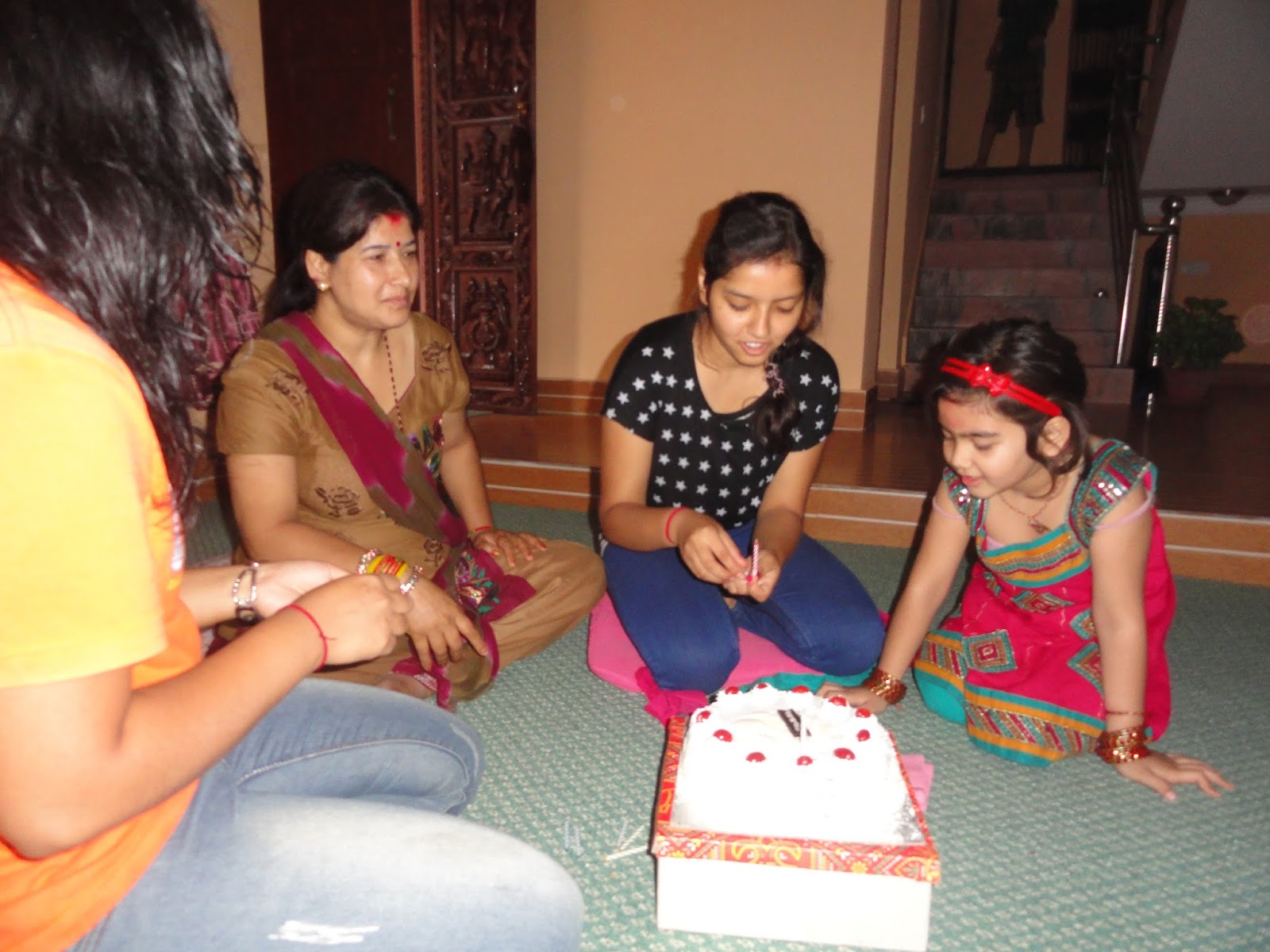
If you are paying close attention, you may have noticed that my host sister’s name is Rakshya just like this holiday. Which is simply because she was born on Rakshya Bandhan! But being born on a holiday that is determined by the full moon, means that this year was the first time that her calendar birthday has fallen on the actual Rakshya Bandhan day, since the original occurrence of course. To celebrate we enjoyed a Nepali birthday cake complete with those obnoxious candles that keep relighting themselves after you blow them out. I also learned that smearing cake, the way Americans sometimes do at weddings, is an appropriate gesture during a birthday celebration in my Nepali family. I didn’t start it, but after my host sister got me with a big smear of frosting I did not hesitate to return her kindness!


Gaijatra (pronounced GUY-jah-trah)
This is a very popular Newari festival that literally means “the procession of cows.” Supposedly, this began after a prince died and the king wanted desperately to cheer up his grief-stricken queen so he called all the people and offered to reward anyone who could make her laugh. The holiday includes lots of dancing, singing, and satirical jokes about society, life, and death. It is a very light-hearted festival and I really enjoyed observing the traditional celebrations.


In the picture above, all of the dancers are dressed completely different than anything you would see regularly. Some of the men are meant to look like cows, some are hunters, and some are women. They performed a dance throughout their small town at the edge of the Kathmandu Valley. I was only there with two other ETA’s so I don’t know the full story of everything that was happening, but I really enjoyed just being part of the crowd.

Shree Krishna Janmastami
Everyone gets a day off of school to celebrate Lord Krishna’s Birthday. When I first heard this I thought, “Wow! That’s really cool that a whole country gets the day to celebrate the birth of a god from one particular religion!” And then I remembered Christmas.

Unlike Christmas, this was a pretty uneventful holiday in my family. We mostly just enjoyed the day off school to get work done around the house.

Father’s Day
Very similar to the American Father’s Day, this was just a day an auspicious day to recognize all of the work that dad’s do to raise a family. Since it was on a Thursday this year, it of course meant another day without school for me. The way this holiday is celebrated really depends on the size of the extended family, and the age of the children. My host parents went to my host mom’s house for a small family gathering. My host siblings said that when they were younger there used to be a big celebration on their dad’s side of the family as well but that has changed as grandkids have grown up and the western idea of a nuclear family, combined with throngs of young people leaving home to find work, has made its way into popular culture.
 
In my family, it was basically a day to give my host dad special foods. My mom made a particular kind of rice (which you eat with a spoon, as opposed to the rice that you eat with your hands. I’m still pretty boggled about why people who can devour a foothill sized pile of rice covered in lentil sauce in ten milliseconds find eating this particular rice dish, which does not include a liquid component, better to eat with a spoon. But whatever.) We also enjoyed greenish ice cream with chocolate chips in it. I thought it was mint chocolate chip but my family claims it was pistachio. Since I don’t have any other experience with pistachio ice cream I can’t say for certain, and the flavor wasn’t terribly strong, but it was great to eat something cold and familiar.

***
The next big holiday is a women's festival called Teej, but there is so much to share that it deserves its own post. So consider this part one in a many part series...

Monday, September 2, 2013

Mero Pariwaar

I have been so fortunate to have had such a wonderful family taking care of me this past week. Perhaps as a lingering consequence of dehydration, I have decided the best way to summarize my family is within the context of being stranded on a deserted island.

Ba / Buwaa (my host dad): you want him there for two reasons. First, he plays serious badminton every morning so he will be good at waving down rescue helicopters. Secondly, he is facebook friends with everyone so when he doesn’t post anything for a few days all of Lalitpur will be out looking for you.
Aama (my host mom): she is a great cook, and while everyone else will probably feel severely rationed, deserted island size portions would probably be perfect for me. Besides being a wonderful chef, Aama is very in-tune with how to handle gossip and petty politics so she wouldn’t allow the group to become divided or chaotic.
Rashmee (my older sister): she studied pharmacology and can tell you the scientific name of anything. She is your key to wilderness survival and healthcare.
Rakshya (my 19 year old younger sister): she just started college and is majoring in social work, which is perfect because she is very patient and caring in nature. I predict that she would emerge as the island peacemaker, ensuring that everyone contributed to building a shelter, gathering firewood, etc.
Raman (my 17 year old younger brother): he just got new glasses, which will come in handy for magnifying the sunlight to make a signal fire. Additionally, he loves scary movies and could probably retell them as entertainment around the aforementioned fire.

L to R: Rakshya, my 8 year old cousin, Rashmee, another cousin, and Raman.
(I PROMISE that I will post a photo of the whole family as soon as I have one! The occasion for a family pic simply hasn’t arisen yet, and everybody puts on house clothes – basically pajamas – when they come home from work/school so a spontaneous evening pic is not on anyone’s agenda.)

Sunday, September 1, 2013

Grab the Go Barrel!


(From August 31, 2013)

Today was a fairly typical Nepali day... given that everyday in Nepal is filled with things I don't quite understand or anticipate.

I woke up at 6am, had my first cup of black tea, and did some morning yoga. Then I took a shower in cold, cold water. (I'm not sure what I will do in December!) at 8:30am I ate breakfast and then left for school. It is approximately one kilometer from my house to school so my day begins with a pleasant walk.

It was not a regular school day (I'm beginning to wonder if a regular school day even exists), but it was the day when students come to receive the results of their first term exams. So there weren't any classes. I spent my morning preparing some introduction cards about myself to use with students when I start teaching next week. I also spent time getting to know some of the other primary school teachers.

After school, I came back to the house, took a nap, read, studied some Nepali letters, and worked on creating a rubric to measure English language proficiency. Then of course there was evening rice and time with the whole family; in the evening they often band together in a concerted effort to improve my Nepali. Some of the sounds in this language just don't seem possible for me!

At 10:00 I headed to bed, and by 10:30 I was fast asleep.

At approximately 11:30pm I slept through my first Nepali earthquake. The shaking we felt in Kathmandu (and by we I mean everyone else who woke up) was a result of a 5.1 magnitude quake with its epicenter in Xinjiang, China. My family described it as "such a big one!" and "it just kept shaking and I was like 'let it stop!'" There was the initial quake and one aftershock; I slept through both of them.

At 11:32pm, my family came and woke me up and we all headed outside. It seemed like everyone in the area was awake. Dogs were barking and lights were on in lots of houses. We waited outside for awhile, but the excitement seemed to die down so we moved back inside out of the cold night air. We spent another 20 minutes or so waiting in the living room to see if there would be more aftershocks, but didn't feel anything. The whole time, my family made light-hearted jokes about being hungry and wanting to pull out the "go barrel." The giant blue bucket is still humorous, but it does take on a more serious note when you are pulled out of bed in the middle of the night. It was nice to know that if I needed it, I had everything important all in one place, ready go... even if "go" means me rolling the barrel on the ground in front of me!

So now it's 12:26am. Everyone is back in their own beds and I assume everyone else is sleeping. I'm pretty unaccustomed to earthquakes and even though I didn't feel it, the whole event was a lot of sudden excitement, so I'm not sure how quickly I'll fall asleep after I finish writing this.

But all is well. I am safe. The house is still standing. The go barrel is still locked and in its place. The next time I'll try to be awake so that I can give a better account :)

Friday, August 30, 2013

Mero Ghar


Mero Ghar = My House
Meh-row gar (rhymes with bar)

Click on any of the pictures below to see them larger.

Technically two houses, both owned by my family. We live in the more modern house that you can just see peeking out behind the one in front. Follow the sidewalk to the left of the house with the blue shutters (old house).

My bedroom. I love love love the giant window, even if the old house obscures a lot of my view.


The living room. There is currently no furniture because my family just moved over from the old house. Most Nepali families, especially those with enough money for two houses, have couches and coffee tables etc.
 

The view from the backdoor. This is what I see when I wash dishes.
 
One view from the rooftop.
 
Looking the other direction; you can see the neighbors more traditional brick house.


Wednesday, August 28, 2013

Weekly Recap

Here is what I composed while lying in bed with a fever in a feeble attempt to catch-up after a week of blog delinquency. I really do promise that things will get better soon, or at least I have very strong intentions of that happening.

***

Monday – New Home
Arrive in Godavari and am confronted with my first plate of rice within five minutes of entering my homestay. Imagine a plate (in America you would probably refer to something this size as a platter) at least 12 inches in diameter. Now fill at least half the plate with a mound of rice three inches tall. Add lentils and broth. Eat. Just as you triumphantly glimpse a shimmer that must mean you are nearing the bottom of rice mountain… your host mom kindly spoons “just a little more” in front of you. (And to be clear, what is considered a little more in Nepal is definitely the equivalent of a complete second helping where I live.)

Tuesday – First day at my school!
Turns out to be an exam day so only the upper level students are there and they are literally just taking exams all day. I watched for awhile and then went home.

Wednesday – Raksha Bandhan (no school)

Thursday – Gaijatra (no school)

Friday – Return to school to administer a listening and speaking exam for students in grades 9 and 10. Basically, I sat at a desk in the hallway with 3-4 other teachers, and students were called one at a time to come and answer a series of questions with one of us. Questions ranged from basic introduction to giving directions on a map or telling a story in the past tense. I tried to smile extra nicely at my students who I’m sure were cursing in their minds when they walked out and realized they had to speak with that weird foreign girl with the crazy American accent.

 Saturday – Saturday (no school)
Brave the public bus system to go into Kathmandu with my host sister and another ETA, Sydney, to get blouses ordered for saris. Apparently everyone wears a sari at Tij, an upcoming women’s holiday, so I needed to prepare. My host mom was disappointed that I did not get a shiny/sparkly sari blouse, but I’m very content with the plain red one; I don’t think I need bedazzlements to attract attention to myself. I promise to post a photo when everything comes in from the tailor.

Sunday – school
Yes, that’s right. I might have a million seemingly-random holidays and I don’t have to be at work until 10, but the normal school week is Sunday-Friday so it’s not all unicorns and rainbows. This was my first real day and I was so excited to see the students, meet more of the teachers, observe some classes, and get a regular schedule mapped out; my American upbringing has resulted in a strong craving for routine and punctuality that is difficult to fulfill here. I will write more about the school itself in another post; let’s just say I still have a lot of questions at the end of day one. Perhaps I would know more if I hadn’t missed the next two days of school…home sick.

Monday and Tuesday – bacteria in my belly
Headache + nausea + fever + “southern internal disturbance” = trip to the clinic. Unfortunately, all of my tests came back inconclusive which is good because I probably don’t have typhoid or hepatitis A (seriously though, that is good news), but bad because I don’t know exactly what is causing such unhappiness in my body. Hopefully a few days of cipro and some strict dietary adjustments will get me back on track.

Wednesday – no school
I’m not even sure why tomorrow is a holiday, but it will be nice to have one more day of recovery before I head back to school. (Correction – today was Krisna’s birthday so that’s why we didn’t have school.)

So this week, if you can, enjoy a glass of potable water straight from the tap and think of me J

Sunday, August 18, 2013

Moving Day!

So long Kathmandu. Hello Godavari.
**Click on the pictures below to see them larger.**


Yellow pin: where I've been staying / Pink: the Fulbright office / Blue: Dhapakel / Green: my new home
Gorkha is where six of the other ETAs will be living and teaching. It's about 6 hours from the pink pin.


Here's a picture taken from the road near Dhapakel (the bright blue pin on the map -- not Gorkha). 


Sunday, July 28, 2013

A is for pomegranate.


(From 24 July 2013)
Only two days in and my Nepali language skills have grown exponentially. Learning how to write devanagari (deh-van-AG-ar-e) script reminds me of learning to count in other bases. Not knowing the basics- like the alphabet- is humbling, but already understanding the larger concept makes progress exhilaratingly quick.
Today we learned our first phonemes: a, aa, ka, kaa, ma, and maa. There’s a picture below with some of the devanagari characters, the English letter(s) they represent, and an English word where the beginning sound is a good approximation of the phoneme. (Keep in mind that I'm just learning to write the characters, let alone write them on the touch screen of my computer!)

The best part is learning the Nepali words that typically go with each letter. A is for anaar (pomegranate), AA is for aama (mother), KA is for kamal (lotus flower), and MA is for maachhaa (fish). It’s a weird concept to wrap your head around.

Besides learning how to read and write, we have also done a lot of work with listening and speaking. Mostly key phrases and simple conversations, but even a few words in Nepali can help you get the lower “local prices” as opposed to the much higher amounts casually paid by unassuming tourists. Someday when the internet is being cooperative I will try to upload a video so you can hear ali ali (a little) Nepali.