Showing posts with label Festival. Show all posts

Saturday, November 16, 2013

Tihar


Tihar is a grand celebration basically centered around the victory of good over evil. It is praised as a holiday for all castes and religions and celebrated throughout Nepal. Many people told me that even though Tihar is shorter than Dashain it is their favorite holiday of the year.
 
There is lots to do in terms of decorating the house. Garlands are made and draped on every window and every door. A grand mandala or rangoli is put on the ground outside the house and the path leads all the way to the space inside the home where puja, worship, takes place.

The mandala or rangoli that we created out of tika
powder on the ground in front of the house.
Making the mandala.


A marigold garland along the door frame.


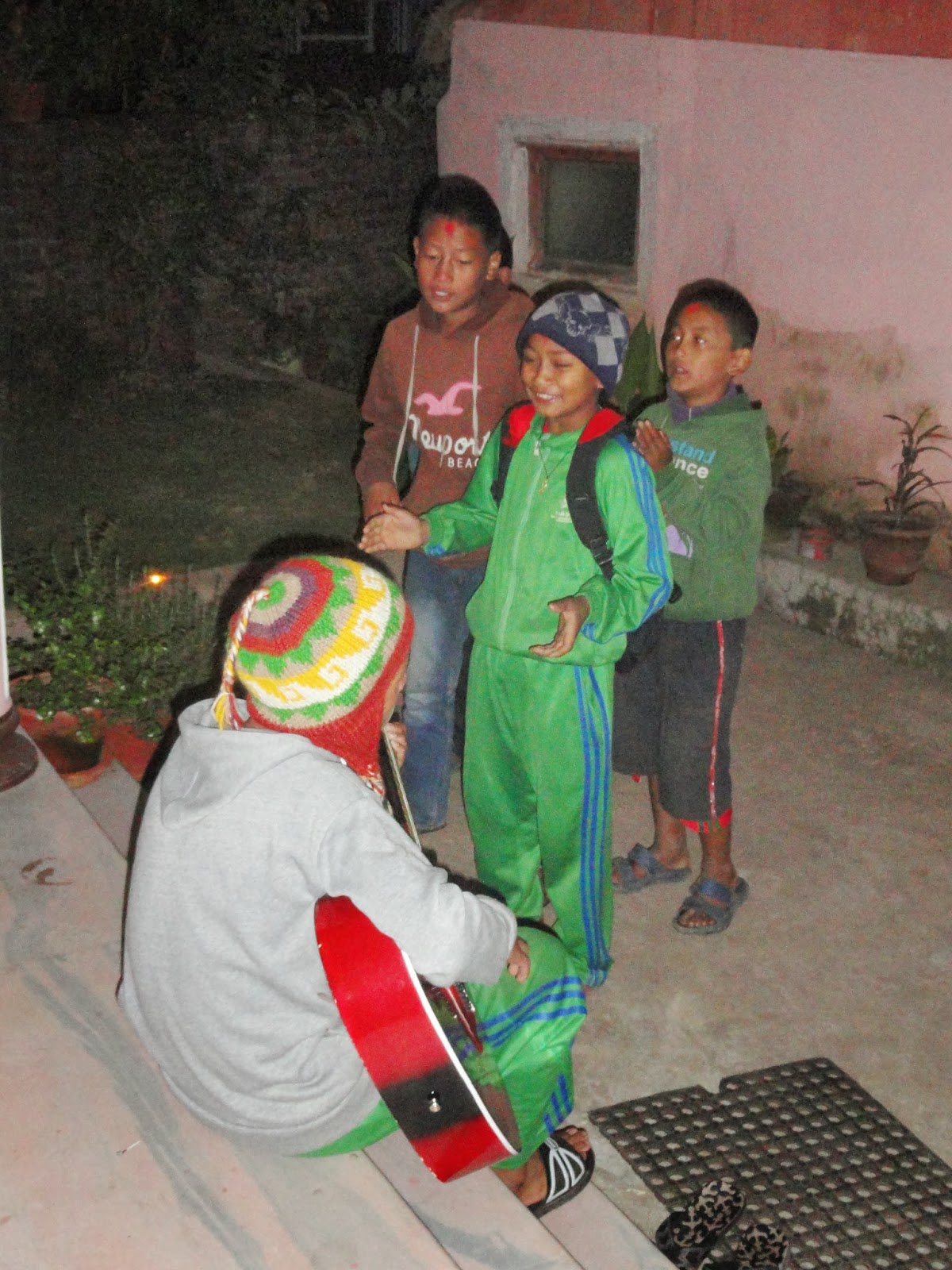
For two nights, all the houses are lit up and groups of kids come around asking for money and gifts. It's like the strange offspring of Christmas and Halloween.
Some electric lights and a lot of candles.
These kids showed off by bringing a guitar. Most groups are just 3-8 children singing/chanting.
 
During the day, kids enjoy giant swings built from rope and bamboo. And by kids I mean kids of all ages. Not only did my host siblings and I enjoy it, but two women who I would guess were in their 50's were waiting in line to take a turn after us! **Correction: giant swings, called pings, are actually constructed for Dashain not Tihar. In my family it just so happened that we didn't find one during Dashain and later happened upon a leftover one.**


The guy in the picture is standing on the swing, he's just got his legs bent to build more momentum.

Worship is directed towards certain things on certain days. There were days of puja for dogs, and crows, cows. My family doesn't have a dog so one of the neighbors brought their dog over and we put a garland and tika on it. There was some confusion regarding the astronomical date for the cow puja. I ended up not being witness to the event because my host mom went and did it early one morning somewhere else since our family does not have a cow.
 
 
It took some convincing (read bribery with food) for the dog to wear the garland.
And the cow is someone else's that I saw in a field on the way to the giant swing.
 
 Using thin twigs and two leaves little "boats" are made. This is what holds the offering during puja.
I asked my host mom to teach me how to make them. It's tricky business!
 
 
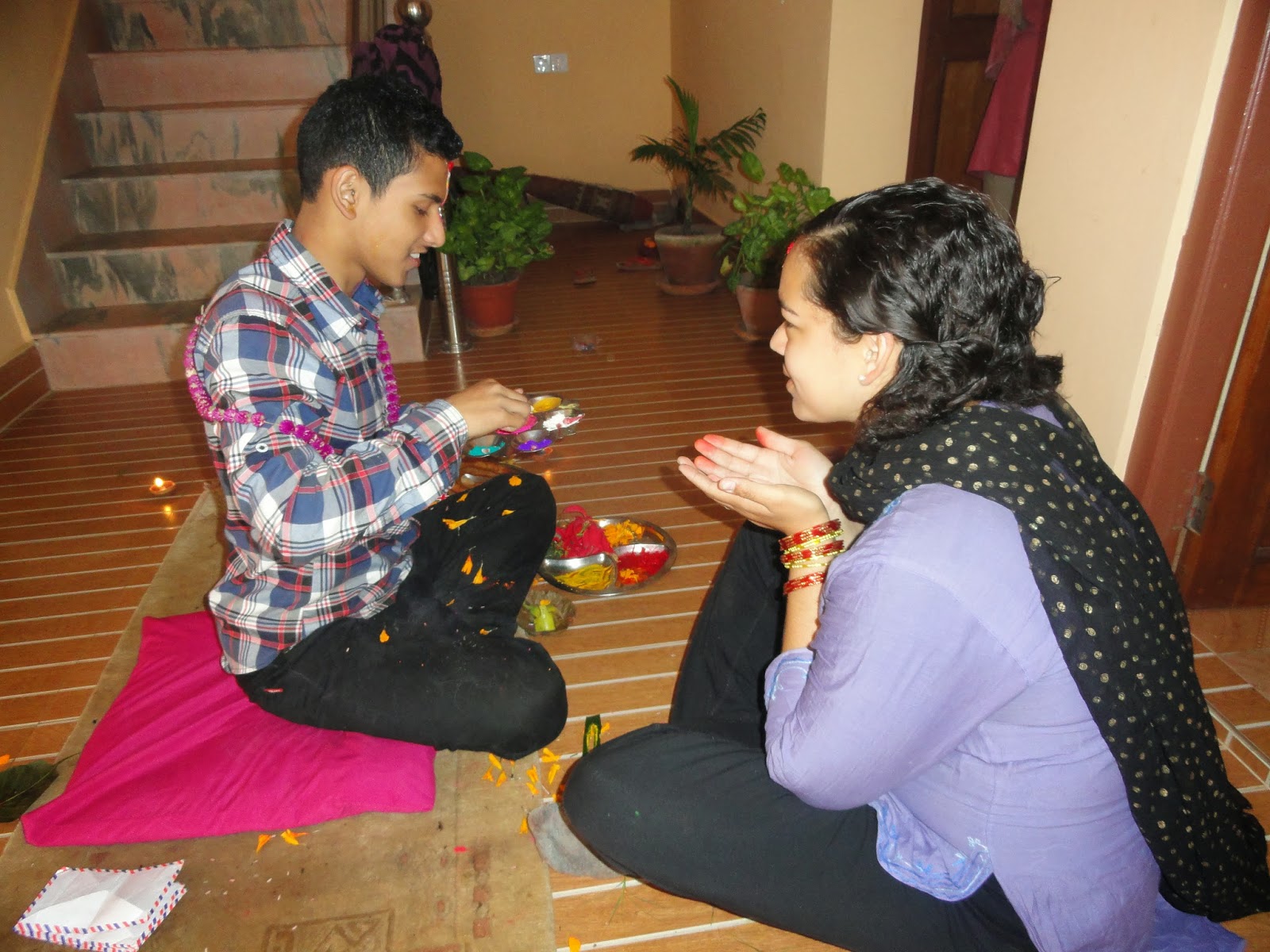
On the last day we celebrated brothers. This involved a particular kind of tika with seven colors; normally there is just red or yellow. Plus lots of gifts --mostly food-- from sisters to their brothers! (But then the brothers have to give money to the sisters.)


**Sorry for the insane photo layout and lack of captions at the end. Sometimes I love blogger and sometimes the way this website handles images makes me want to swear off ever trying to post pictures. But don't worry, I promise not to resort to that! You'll just have to tolerate less than aesthetically pleasing combinations of photos.


Tuesday, September 10, 2013

Holidays: Part Two (Teej)

Teej (pronounced TEA-juh)
Teej is a festival for women. And it’s a big deal. The holiday itself is on Sunday, but the celebrations span many days on either side. The weekend before, my family went to see relatives in Kalanki (part of Kathmandu) for a pre-Teej meal. On the Friday before, all of the female teachers at my school headed into the city for some kind of program/event/party. I went with Sydney, another ETA in Lalitpur, to the Teej Celebration with the ACCESS students. (ACCESS is a U.S. Embassy program providing extra English classes to academically talented but financially disadvantaged students in Nepal’s government schools.) I don’t know what I was expecting the program to be like, but it was pretty much all dancing. Oh, except the part where Sydney and I were asked to “say a few words” with less than 30 seconds warning. At least we were able to leave before they asked us to dance in front of everyone!

The group photo, sorry for the quality it wasn't my camera.
One of the dances performed by the access students.

During Teej, women fast to improve their chances of getting a good husband and/or to improve their husband’s chances of living a long and prosperous life. Just another example of women doing all the work! Although men may be at the motivation of the holiday, the festival really is for the women. Everyone dresses up and spends the whole day at the temple singing and dancing. How strict you choose to fast is kind of an individual decision, with more and more women becoming pretty relaxed, although some still commit to abstaining from even water between dawn and dusk. Of course, Nepali stomachs are used to giant platters of rice so in preparation for a single day of fasting you eat like there will be an eternal famine. Fortunately, my family is now accustomed to the fact that I am a dinner time annomally, and they just laugh when I thrust my left hand (unclean) over my plate and yell pugyo! as my aama comes toward me with a second person’s worth of rice.

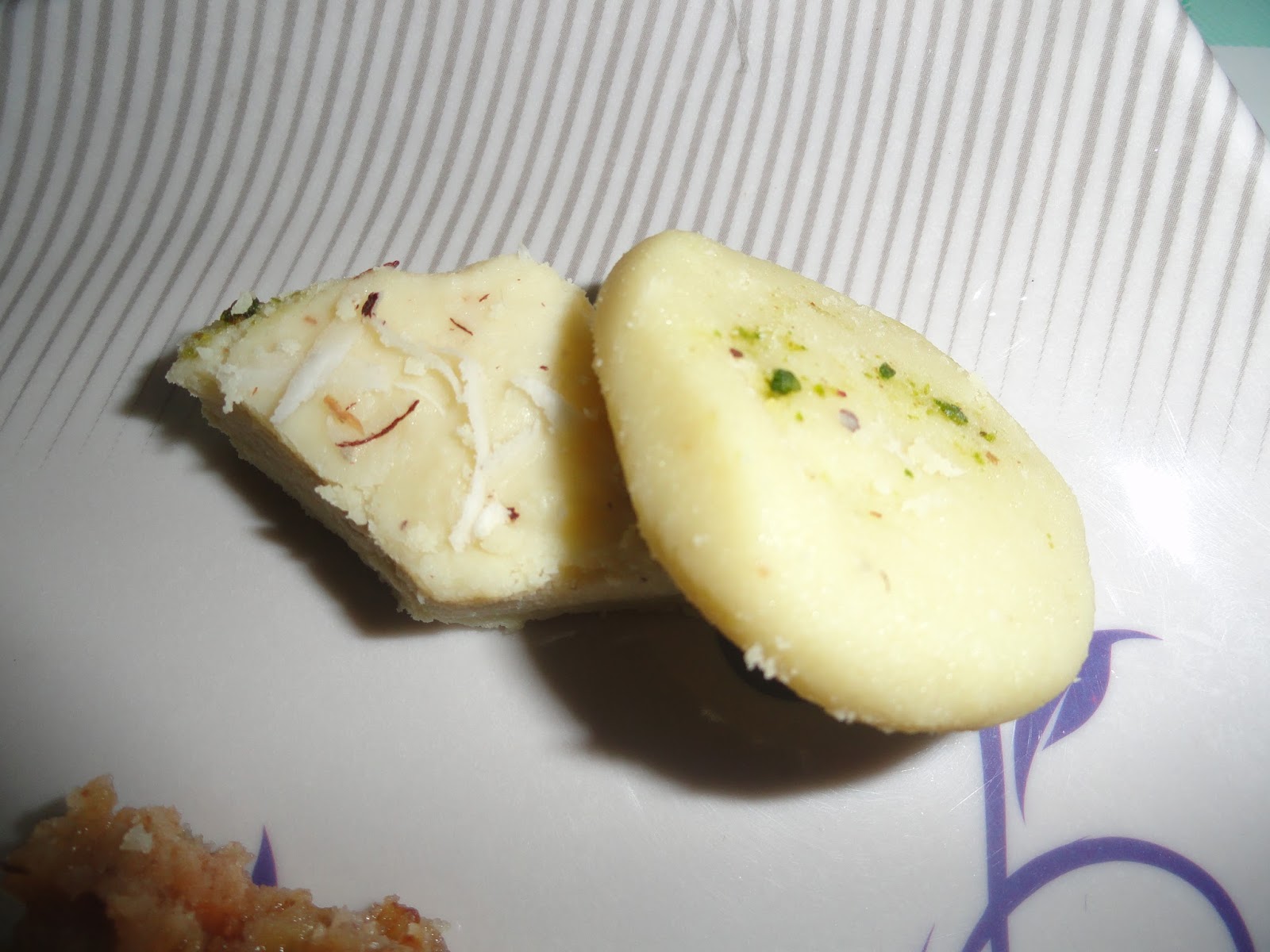
This was my first opportunity to experience many of the festival sweets, including one called barfi which is actually pretty tasty once you can get the unpleasant vomit image out of your mind. 

 lalmon and yogurt: a ball of fried dough soaked overnight in a sugar syrup
 
 barfi and pehda: both are sweets made from concentrated milk
(Milk can be turned into a lot of things here with varying consistencies, I don't ask too many questions.)
 
Japanese Pears and Gudhpak: the second thing is a mix of dried fruits and some other stuff that I'm not certain how to identify. It kind of reminds me of apple crisp topping in terms of sweetness and the combination of sticky/crumbly.


Jeri: fried concentric circles which are also soaked in a sugar syrup.
Because fried foods aren't unhealthy enough!


 Here's what the actual day of Teej looked like at my house.
 
1. Had my toes/feet painted red by a woman who travels around stopping at every house to give married women a full pedicure. (Technically, this happened the day before, but close enough.) Having very red feet from a water soluble dye also meant I had to be very careful about wearing shoes anytime I was on the carpet.

Me and my two sisters. I asked for just the tips of my toes, but something got lost in translation.
 
2. Wore my first sari! If you haven't had the opportunity to sport this traditional wraplike outfit here is the gist. First you put on a "blouse" which is a mix between a bra and a very short cut-off tee shirt. If you wore this "blouse" as a regular blouse anywhere in the United States it would be strongly frowned upon. Then there is a petticoat, which is basically just  cotton skirt, in the same color as the sari, with a drawstring waist. The key to the whole outfit is making sure that waist is tied very tight because that is what all the yardage of the sari is supported by. Over the blouse and petticoat goes an long length of colorful fabric, the sari itself. I would try to describe how to wrap the sari, but I know I couldn't do it justice. There is a lot of tucking, pleating, more tucking, and since I'm new to the whole business also some pinning!
Me and my Aama.
 
3. Girls with long hair often put red or black fabric into their braids. The dhago strands also have ornaments at the bottom for extra sparkle. My hair is a little short so I opted out of this aspect.
 
4. Added 12 additional bangles to my existing dozen; red ones this time even though I'm not married. I also wore pote, a beaded necklace, which is normally only for married women. My host family decided I should get the full experience, and this way none of the Nepali men bothered me. In fact, a lot of people who saw me just assumed I was married to a Nepali already.

5. Affixed a bindi and a tika to my forehead. The bindi is the decorative circle between my eyebrows and the tika is the red smudge closer to my hairline.


After getting dressed, I went to the temple with my two host sisters and my Nepali aama. There was a long line of women, all glowing in vibrant red cloth, waiting to do puja, worship. The scene was visually exciting, but actually quite calm within the temple. I did not partake in the actual worship of the various deities, but I still felt very honored to be welcomed into a sacred space.
 
 
The final event was a dance party. There were lots of these little gatherings going on in the area, and we had passed at least three during the walk to the temple. At first the plan was to return to a celebration closer to the house, but then my host mom spotted a friend under an awning just around the corner from the temple. We joined a group of women chatting and dancing to pass the time during the fast. We were in a large cement pavilion with speakers set-up for music, but I'm not sure who (if anyone) was really hosting the party. It wasn't long before my host sister became the official DJ, playing music off of her phone. I'm not much of a dancer, and even less so when everyone around is taking my picture on their cell phone camera, but I enjoyed the afternoon letting all sorts of women - old and young - try to teach me how to dance.


For me, Teej can be summed up in the word saturated. It is a traditional holiday deeply rooted in practices and rituals from an earlier time, and there is a richness that comes with that history. At the same time, the tone of the day is changing as modern western influences seep further into Nepal. I had a long conversation with my host sister about Teej as it relates to gender equality; ultimately she concluded that Teej is about women displaying their bond with their husbands rather than their servitude. I am quite happy to accept her positive perspective.  The colors are bright and the foods are sweet. For me, Teej was lovely (ramilo chha).
 
A proper family photo: me, Rakshya, Baa, Aama, Raman, and Rashmee.

Sunday, September 8, 2013

Holidays: Part One

It’s festival season in Nepal. Kind of like the frenzy between Thanksgiving and New Year’s but on steroids. I have been in Godavari for three weeks which technically should amount to 18 days of school, but the actual number is only 12. So literally one out of every three days is a vacation day, not including the Saturdays that are always off. Here’s a quick review of the festivals that have happened so far:

 As you read, please keep in mind that I am experiencing each of these things within the context of one year and one particular family in one particular region of Nepal. The same way that one family’s Christmas traditions do not reflect all families, my experience may not generalize to other people, places, and times. Try your best not to reduce an entire country’s spiritual and cultural identity to the size of my meager understanding.

Rakshya Bandhan (pronounced RAWK-shah BAHN-dah)
Also known as Janai Purnima (pronounced juh-nai purr-nee-mah), this is the festival of the sacred thread. In some places, a priest ties the thread as a symbol of protection and prosperity. In others, sisters tie the thread onto their brothers’ wrists. In my host family, it was the maternal grandfather (maamaa) who tied the thread onto the wrists of the younger generation. He also gave everyone a tika, which is a clump of red rice paste on the forehead as a sign of blessing.


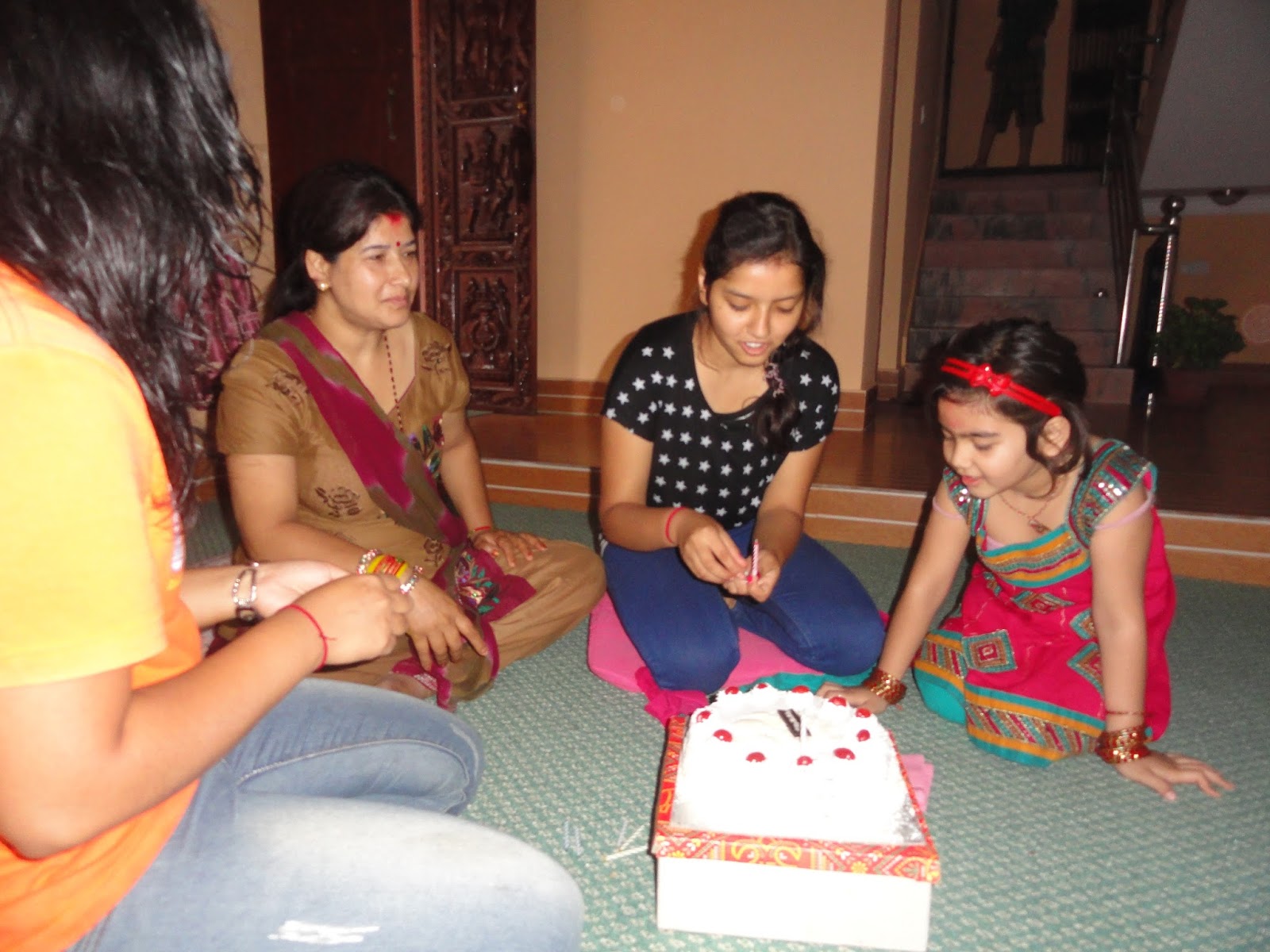
If you are paying close attention, you may have noticed that my host sister’s name is Rakshya just like this holiday. Which is simply because she was born on Rakshya Bandhan! But being born on a holiday that is determined by the full moon, means that this year was the first time that her calendar birthday has fallen on the actual Rakshya Bandhan day, since the original occurrence of course. To celebrate we enjoyed a Nepali birthday cake complete with those obnoxious candles that keep relighting themselves after you blow them out. I also learned that smearing cake, the way Americans sometimes do at weddings, is an appropriate gesture during a birthday celebration in my Nepali family. I didn’t start it, but after my host sister got me with a big smear of frosting I did not hesitate to return her kindness!


Gaijatra (pronounced GUY-jah-trah)
This is a very popular Newari festival that literally means “the procession of cows.” Supposedly, this began after a prince died and the king wanted desperately to cheer up his grief-stricken queen so he called all the people and offered to reward anyone who could make her laugh. The holiday includes lots of dancing, singing, and satirical jokes about society, life, and death. It is a very light-hearted festival and I really enjoyed observing the traditional celebrations.


In the picture above, all of the dancers are dressed completely different than anything you would see regularly. Some of the men are meant to look like cows, some are hunters, and some are women. They performed a dance throughout their small town at the edge of the Kathmandu Valley. I was only there with two other ETA’s so I don’t know the full story of everything that was happening, but I really enjoyed just being part of the crowd.

Shree Krishna Janmastami
Everyone gets a day off of school to celebrate Lord Krishna’s Birthday. When I first heard this I thought, “Wow! That’s really cool that a whole country gets the day to celebrate the birth of a god from one particular religion!” And then I remembered Christmas.

Unlike Christmas, this was a pretty uneventful holiday in my family. We mostly just enjoyed the day off school to get work done around the house.

Father’s Day
Very similar to the American Father’s Day, this was just a day an auspicious day to recognize all of the work that dad’s do to raise a family. Since it was on a Thursday this year, it of course meant another day without school for me. The way this holiday is celebrated really depends on the size of the extended family, and the age of the children. My host parents went to my host mom’s house for a small family gathering. My host siblings said that when they were younger there used to be a big celebration on their dad’s side of the family as well but that has changed as grandkids have grown up and the western idea of a nuclear family, combined with throngs of young people leaving home to find work, has made its way into popular culture.
 
In my family, it was basically a day to give my host dad special foods. My mom made a particular kind of rice (which you eat with a spoon, as opposed to the rice that you eat with your hands. I’m still pretty boggled about why people who can devour a foothill sized pile of rice covered in lentil sauce in ten milliseconds find eating this particular rice dish, which does not include a liquid component, better to eat with a spoon. But whatever.) We also enjoyed greenish ice cream with chocolate chips in it. I thought it was mint chocolate chip but my family claims it was pistachio. Since I don’t have any other experience with pistachio ice cream I can’t say for certain, and the flavor wasn’t terribly strong, but it was great to eat something cold and familiar.

***
The next big holiday is a women's festival called Teej, but there is so much to share that it deserves its own post. So consider this part one in a many part series...